The Coffee Giant: A Journey into Brazilian Coffee
Talking about Brazil means talking about the undisputed world champion when it comes to coffee production and exports. And as you can imagine, its history as a nation is intimately linked to that of this bean.
Coffee arrived in Brazil in the early 18th century, and what began with a simple seedling quickly became the country’s economic engine.
Today, coffee farming is a deeply rooted tradition, ranging from huge plantations to family-run specialty coffee farms.
This immense country offers unparalleled bean diversity, from the exquisite flavour of a low-acidity Arabica to the most sophisticated gourmet coffees. Brazilian origin coffee captivates baristas and the most discerning palates.
The History of Coffee Cultivation in Brazil

The history of coffee in Brazil is worthy of an adventure novel, beginning with an act of smuggling with a romantic twist.
It was 1727 when Major Francisco de Melo Palheta was sent to French Guiana on a diplomatic, though secret, mission to obtain coffee seeds.
Legend has it that he did not succeed through official channels, but instead seduced the wife of the French governor, who gave him seedlings and seeds hidden in a bouquet of flowers as a farewell gift.
These first seedlings were established in Pará and quickly spread throughout the region. Brazil’s climate and soil were perfect, and by the beginning of the 19th century, plantations had expanded to the states of Rio de Janeiro, Minas Gerais and São Paulo.
Coffee became the main source of wealth for the Empire of Brazil, and the country dominated the global market to an astonishing degree, producing more than 80% of the world’s coffee at the beginning of the 20th century.
This period of prosperity for Brazilian origin coffee, known as the coffee cycle, financed the development of cities, the construction of railway infrastructure and the arrival of millions of immigrants, leaving an indelible mark on the country’s national identity.
The Central Pillar: The Importance of Coffee in Brazil’s Economy and Culture

Brazilian coffee is a historical and current pillar of the country’s economy. Although it no longer represents the same percentage of GDP as during the “coffee cycle”, it remains one of the main export commodities, generating billions of dollars and maintaining its position as the world leader.
Its importance is not only macroeconomic, but also directly affects the lives of millions of people: it is estimated that more than 5 million Brazilians are involved in the coffee production chain.
Culturally, coffee is part of the DNA of social life. In Brazil, people do not say they are going to have coffee; they say they are going to have um cafezinho, a small serving of strong, sweet coffee served in small cups, which is a symbol of hospitality and a daily ritual in homes, offices and businesses.
It is the drink used to welcome visitors, close deals and start the morning. From São Paulo’s elites to agricultural workers, cafezinho is a unifying and essential element that transcends social classes.
Reinvent or Die: The Evolution of Coffee Cultivation, Production and Varieties in Brazil
Brazil’s coffee production has undergone several transformations. After the overproduction crises and price declines of the mid-20th century, the industry understood that volume alone was not enough; quality was the future. This has driven tremendous evolution over recent decades.
Historically, the dominant variety has been Arabica ––almost 80% of current production––, but in regions such as Espírito Santo, the cultivation of conilon ––Robusta–– has grown significantly due to its resilience and its essential role in the production of soluble coffee and blends.
When it comes to Arabica varieties, Brazil has been a pioneer in agronomic research, developing cultivars adapted to its climate such as Mundo Novo and Catuaí, which are more robust and productive varieties, ideal for its vast plantations.
Today, evolution is focused on technification, the use of controlled irrigation and the production of traceable specialty coffee, seeking more complex and fruity flavour profiles that move away from traditional industrial coffee.
Cultivation Methods for Brazilian Origin Coffee

Coffee cultivation in Brazil is a unique blend of tradition and high technology. Given the vast size of its plantations and the relatively flat terrain in many regions, Brazil is the country that has invested the most in the mechanisation of harvesting.
While harvesting is entirely manual in mountainous countries, here large automatic harvesters are used to shake the trees and collect the cherries.
This allows for impressive efficiency, but requires expert management, as the machines collect both ripe and unripe cherries. It is therefore essential for farmers to know the optimal time for harvesting.
As for processing, the most common method is the natural or “dry” process, which is ideal for Brazil’s climate. The cherries are dried whole, transferring sugars and chocolate or nutty notes to the bean and creating that classic Brazilian coffee flavour.
However, on specialty farms, the pulped natural or honey process is becoming increasingly popular. The skin is removed while part of the mucilage ––the sticky pulp–– is left on the bean during drying, creating greater sweetness and complexity in the cup.
Sustainable cultivation and certification of Brazilian origin coffee are becoming increasingly important, especially on larger plantations.
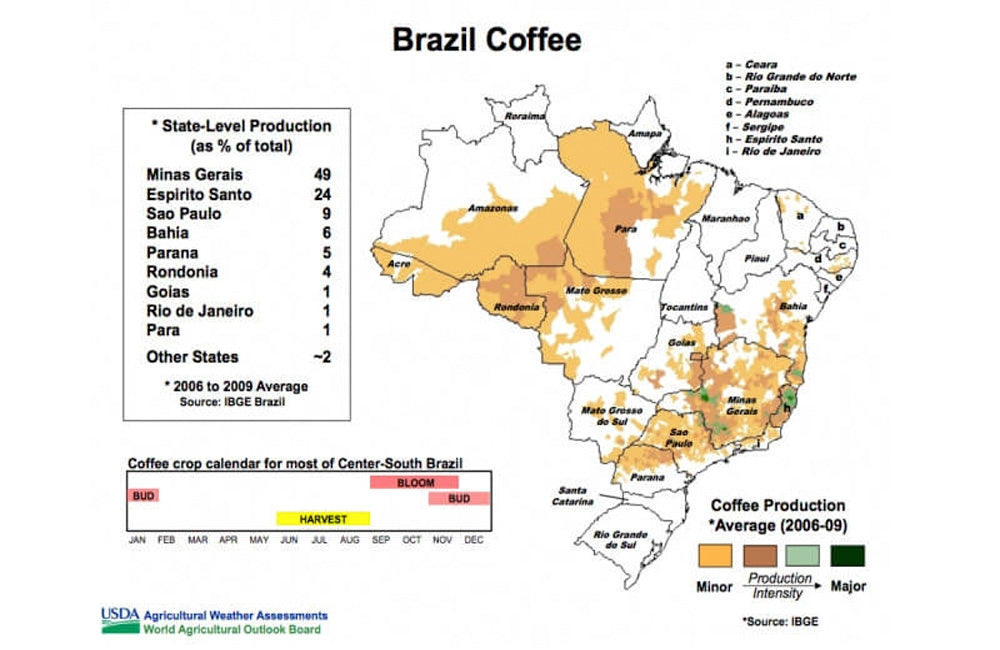
The Great Map of Brazil’s Main Coffee-Growing Regions
Brazil is a continental country and its coffee-growing regions are as diverse as its landscapes. From the high plateaus of Minas Gerais to the coastal valleys of Bahia, each state contributes a unique flavour profile.
The scale of Brazilian production means there is coffee for every taste, from commodity coffee for blends to gourmet microlots.
Brazil Coffee-Growing Region: Minas Gerais
- Location: the largest coffee-producing state, located in southeastern Brazil.
- Key areas: includes Cerrado Mineiro ––Brazil’s first coffee PDO––, Sul de Minas and Matas de Minas.
- Production: more than 50% of Brazil’s total coffee production.
- Coffee varieties: predominantly Arabica ––Mundo Novo, Catuaí, Yellow Bourbon––.
- Altitude: between 800 and 1,300 metres.
- Climate: well-defined dry and wet seasons, ideal for sun drying.
- Cultivation type: large, technologically advanced farms predominate, especially in Cerrado Mineiro, alongside small and medium-sized farms in Sul de Minas.
- Processing type: mainly natural and pulped natural, producing sweet and chocolatey profiles.
Brazil Coffee-Growing Region: São Paulo
- Location: in the southeast, a state historically crucial to coffee.
- Key areas: Alta Mogiana, known for its quality and the historic tradition of large farms.
- Production: historically high, although its share has declined compared with Minas Gerais; it remains a significant producer.
- Coffee varieties: mainly Arabica ––Catuaí, Mundo Novo––.
- Altitude: between 800 and 1,200 metres.
- Climate: moderate temperatures that favour cultivation.
- Cultivation type: large and medium-sized farms, many of them using automatic harvesters.
- Processing type: natural and washed ––to a lesser extent––, producing a coffee with medium body and balanced flavour.
Brazil Coffee-Growing Region: Bahia
- Location: northeastern Brazil, with growing areas in the Cerrado ––west–– and Chapada Diamantina ––inland––.
- Key areas: Planalto da Bahia ––Café de Altura–– and Oeste Bahiano ––large fazendas––.
- Production: an important producer, with an emphasis on the growth of specialty coffee.
- Coffee varieties: specialty Arabica in the mountains and conilon ––Robusta–– in lower areas.
- Altitude: highly varied; up to 1,400 metres in Chapada Diamantina.
- Climate: Chapada offers a mountain climate, ideal for quality.
- Cultivation type: medium-sized farms investing in quality and traceability.
- Processing type: often pulped natural and washed, seeking acidity and complexity.
Completing the Map of Brazil’s Coffee-Growing Regions

Brazilian coffee is as diverse and vast as its territory, and we could not leave out such representative regions as Paraná, Espírito Santo, Mato Grosso, Mato Grosso do Sul and Chapada de Minas.
In Paraná, in the south of the country, coffees stand out for their smooth body and notes of chocolate and nuts.
Espírito Santo is known for its artisanal production and mountain-grown Arabica coffees, with floral and balanced profiles.
In Mato Grosso and Mato Grosso do Sul, cultivation extends across warmer areas, producing beans with sweet flavours and low acidity.
Finally, in Chapada de Minas, we can find fine, aromatic and highly balanced coffees.
The Coffee Harvest Season in Brazil’s Different Regions

The harvest season is fairly consistent, but varies slightly between regions, mainly depending on the dry-season climate and altitude.
Generally, harvesting takes place during the driest months of the year: from May to September.
Brazil’s coffee harvest calendar would look roughly like this:
- Medium-altitude regions ––Minas Gerais, São Paulo––: the main harvest usually begins in May/June and continues through August. Large fazendas aim to harvest when most cherries are ripe in order to maximise harvester efficiency.
- Higher-altitude regions ––parts of Bahia, Matas de Minas––: ripening is slower in these areas. Harvesting may be delayed and concentrated more heavily in July, August and sometimes September. This is ideal for specialty coffees, where slower ripening favours flavour complexity.
The predominant harvesting method is strip picking ––collecting all the cherries at once–– by machine or by hand, but specialty farms are increasingly adopting selective picking ––manual selective harvesting–– to ensure that only beans at their optimum ripeness are processed.
Precise management of the Brazilian coffee season is key to quality, especially for natural and pulped natural coffees that depend on dry weather for drying.
Coffee Growers and the Brazilian Coffee Supply Chain
Brazilian coffee is the result of the work of a vast network of people, from farmers to exporters.
Most production comes from large and medium-sized fazendas, many of them family businesses that have invested heavily in technology.
Unlike in other countries, mechanisation is common, requiring significant capital investment but also providing efficiencies that keep Brazilian coffee competitive worldwide.
The income these farmers receive is directly linked to international prices set by the New York Stock Exchange and the quality of their harvest.
In terms of organisation, there are strong associations and cooperatives, especially in areas such as Cerrado Mineiro, which provide technical support, financing and quality certifications.
However, on a day-to-day basis, the supply chain includes other key players:
- Intermediaries or corretores: they act as a link between smaller farms and large exporting companies or domestic roasters.
- The Brazilian government: historically crucial, the government managed coffee reserves to stabilise prices. Although intervention is lower today, the government provides support through EMBRAPA ––the Brazilian Agricultural Research Corporation–– by developing new varieties and cultivation techniques.
- Coffee export companies: they are the final link bringing Brazilian coffee to the rest of the world. They control logistics, final quality control and international negotiations. Many are multinational companies, but there are also Brazilian traders specialising in origin and specialty coffee.
In short, Brazilian coffee is the result of a highly organised and professionalised industry that balances massive scale with a growing commitment to high-quality coffee.
Where to Buy the Best Brazilian Coffees
We hope you enjoyed this article about Brazilian coffee, an origin that is increasingly focused on quality and is striving to secure a leading place in the specialty coffee sector.
If you want to try some of the outstanding Latin American coffees, you can find them freshly roasted at Ineffable Coffee in Seville, with all the care and attention they deserve.
Visit the shop to get some of the surprising specialty coffees from Brazilian origin that you can find both ground and whole bean, and enjoy an exquisite cup of coffee, whether espresso or filter, just the way you like it.