Costa Rica, that small but vibrant Central American country, is not only famous for its biodiversity, paradise beaches and impressive volcanoes, but also for being home to one of the most prestigious coffees in the world.
Costa Rican origin coffee has a long history dating back to the 18th century, when the first Arabica seeds arrived in the country. Since then, coffee has been an economic engine, a cultural symbol and an international calling card.
Today, its quality, supported by sustainable cultivation methods and privileged growing regions, makes it a gem within the world of coffee.
The history of coffee cultivation in Costa Rica
Coffee arrived in Costa Rica at the end of the 18th century from Jamaica, and its volcanic soils and tropical climate quickly proved to be the perfect environment for it to thrive.
During the 19th century, the government promoted cultivation through incentives such as granting land to those willing to plant coffee, allowing thousands of farming families to begin dedicating themselves to coffee production.
Over time, coffee became the country’s first export product and a key driver behind the construction of infrastructure such as roads, railways and even the famous National Theatre of San José, largely financed through taxes derived from its trade.
Costa Rica was a pioneer in the region in prioritising quality over quantity. Since the mid-20th century, the country’s laws have prohibited the planting of Robusta coffee, ensuring that all production consists of Arabica coffee.
This, together with the altitude of its plantations, laid the foundations for an international reputation that continues to this day.

The importance of coffee in Costa Rica’s economy and culture
Costa Rican origin coffee is not just an agricultural product; it is part of the country’s DNA. Economically, it remains one of its most important exports, with key markets in the United States, Europe and Asia.
Thousands of farming families depend directly on its cultivation, while complementary industries such as exporting, agricultural research and coffee tourism generate thousands of additional jobs.
Culturally, coffee has shaped Costa Rican identity. The typical image of the «cafetalero» working with a basket over their shoulder is part of the collective imagination, while the country’s coffee shops are genuine social meeting places.
One example is the traditional homemade coffee preparation known as «chorreado», made using a cloth filter called a chorreador, which shows how coffee has gone beyond agriculture to become part of everyday life.
Even the country’s politics have been influenced by this crop. Coffee-growing elites played a fundamental role in the social and economic organisation of the 19th and 20th centuries.
Today, although coffee competes with emerging sectors such as tourism and technology, its cultural role remains irreplaceable.

The evolution of coffee cultivation, production and varieties in Costa Rica
Coffee cultivation in Costa Rica has evolved through innovation and a constant pursuit of quality. In its early days, production focused on supplying Europe, with relatively small volumes but a strong reputation.
Over the years, the country established itself as a reference point for specialty coffee. Today, the Costa Rican Coffee Institute ––ICAFE–– oversees quality, supports producers and promotes sustainable practices, helping to distinguish Costa Rican coffee in international markets.
In terms of varieties, Costa Rica has focused almost exclusively on Arabica, with varieties such as Caturra, Catuaí and Villa Sarchí, which have shown excellent adaptation to the country’s climate and altitude.
More recently, experimental microlot varieties have been introduced, with controlled fermentations that have won international competitions such as the Cup of Excellence.
This process reflects how Costa Rica not only protects its coffee-growing heritage, but also constantly reinvents it to meet an increasingly demanding global market.

Coffee cultivation methods in Costa Rica
One of the secrets behind the reputation of Costa Rican origin coffee lies in its cultivation methods. Most coffee plantations are located in mountainous areas between 1,200 and 1,800 metres above sea level, providing beans with greater density and flavour complexity.
The country has made a notable effort to promote sustainable practices. Many farms have adopted shade-grown systems that protect biodiversity and preserve the soil.
In addition, organic certification and fair trade have become distinguishing features that attract international consumers.
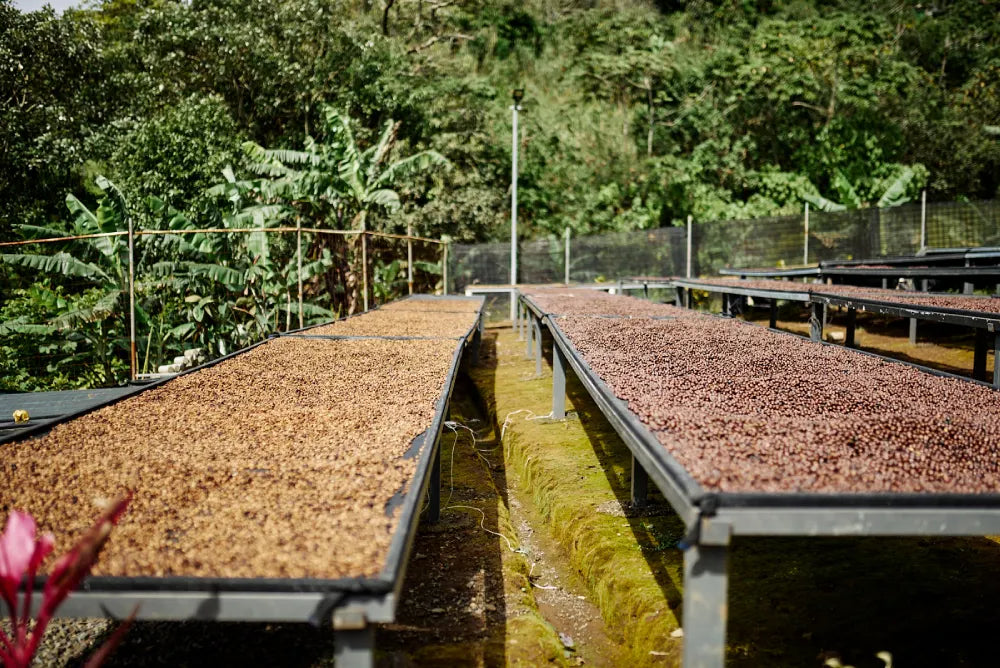
Wet processing is the most common processing method in Costa Rica, where the coffee bean is carefully washed before drying. However, in recent years, alternative methods such as honey and natural have become increasingly popular, bringing more fruity and exotic sensory profiles.
In short, Costa Rican cultivation methods are a blend of tradition and modernity: ancestral techniques refined through science, sustainability and a passion for quality.

The main coffee-growing regions of Costa Rica
Although coffee is produced throughout the country, some regions stand out for their unique altitude, climate and volcanic soils. Each one contributes a distinct flavour profile, making Costa Rican coffee a broad spectrum of sensory experiences.
Costa Rica Central Valley coffee-growing region
- Location: around San José.
- Areas: Alajuela, Heredia and Cartago.
- Share of production: approximately 25% of national production.
- Variety: mainly Caturra and Catuaí.
- Altitude: between 1,200 and 1,700 metres
- Climate: defined rainy season and cool temperatures.
- Cultivation type: shade-grown in volcanic soils.
- Processing: mainly washed, although honey is also used.
Costa Rica Tarrazú coffee-growing region
- Location: mountainous region south of San José.
- Areas: Dota, León Cortés and Tarrazú.
- Share of production: around 35% of the country’s production.
- Variety: Caturra and Catuaí, with experimental microlots.
- Altitude: between 1,500 and 1,900 metres.
- Climate: cool, with cold nights that favour slow maturation.
- Cultivation type: traditional shade-grown cultivation.
- Processing: washed, honey and natural.
Costa Rica Tres Ríos coffee-growing region
- Location: near the city of Cartago.
- Areas: a small region, but one nicknamed «the Bordeaux of coffee».
- Share of production: less than 5% of total production.
- Variety: Caturra and Catuaí.
- Altitude: between 1,200 and 1,650 metres.
- Climate: clearly defined dry and rainy seasons.
- Cultivation type: highly fertile volcanic soils.
- Processing: mostly washed.

Other coffee-growing regions of Costa Rica
To complete the map of coffee cultivation in this Central American country, we want to give you at least a glimpse of the regions of West Valley, Orosi, Brunca, Turrialba and Guanacaste, which reflect the extraordinary diversity of Costa Rican coffee.
In fertile West Valley, coffee plants grow in volcanic soils, producing coffees with bright acidity and notes of fruit and flowers.
Orosi, one of the oldest coffee-growing areas, produces smooth, sweet and balanced cups. In Brunca, in the south, the humid climate favours coffees with a rounded body and notes of honey and cocoa.
Last but not least, Turrialba combines abundant rainfall and moderate altitude, resulting in delicate and aromatic profiles, while Guanacaste stands out for its smooth coffees, with subtle fruity notes and low acidity.
Coffee harvest season in Costa Rica
The Costa Rican coffee harvest season varies depending on the region due to altitude and climate. In general, harvesting takes place between November and March, coinciding with the dry season.
In high-altitude regions such as Tarrazú, harvesting extends until March, as the beans ripen more slowly, resulting in higher quality. In lower-altitude areas, such as Turrialba, harvesting begins earlier, around October.
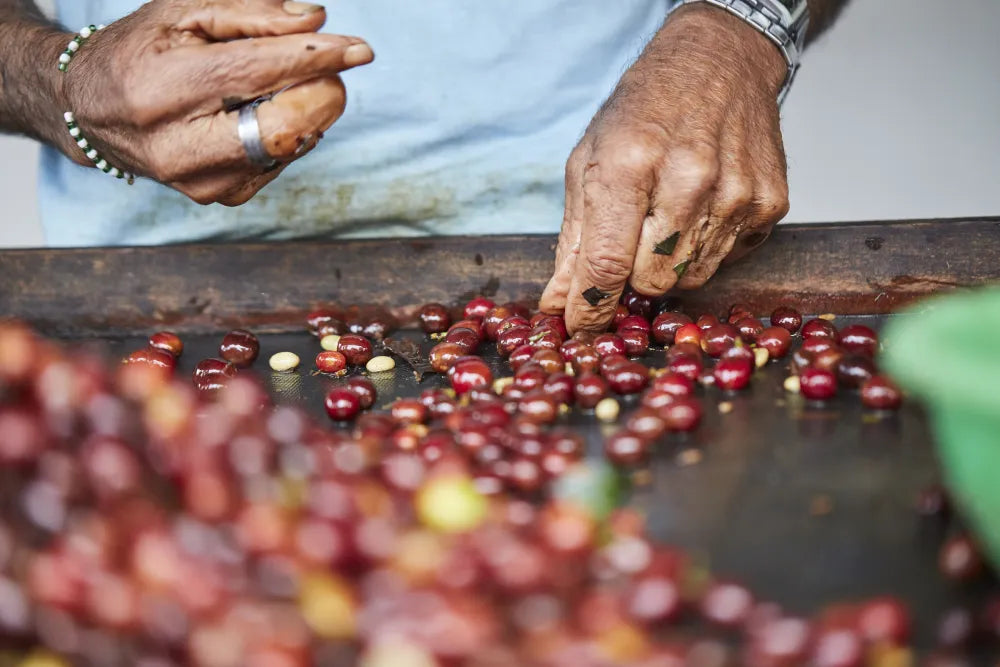
Harvesting is still carried out manually on most farms, ensuring careful selection of ripe beans. Although this practice is more costly and labour-intensive, it is key to maintaining the reputation for excellence of Costa Rican coffee.
Ultimately, the harvest season is not only an agricultural period but also a cultural one: entire families take part in the picking, strengthening traditions and keeping the bond between community and coffee alive.

Coffee growers in Costa Rica
The true protagonists of Costa Rican origin coffee are its growers. Most are smallholder producers who own family farms of less than 5 hectares. These families not only create local employment, but have also passed down coffee-growing knowledge from generation to generation.
Coffee growers are organised into cooperatives, which play an essential role in marketing, access to credit and technical training.
Thanks to these structures, smallholder producers can compete on equal terms with large farms.
As for income, although coffee prices have fluctuated on the international market, quality and fair-trade certifications have allowed many farmers to obtain better prices.
Other actors such as intermediaries, exporters and the Costa Rican government itself are also essential. ICAFE, for example, regulates prices and supports innovation in the sector.
In addition, Costa Rica has invested in coffee tourism, offering farm experiences that complement producers’ income.
Where to buy the best Costa Rican coffees
As you can see, Costa Rican origin coffee is much more than a beverage: it is history, culture, economy and tradition. From fertile volcanic lands to the expert hands of thousands of farming families, every cup tells the story of a country that has made coffee one of its greatest hallmarks.
With sustainable cultivation methods, highly prestigious growing regions and a firm commitment to quality, Costa Rican coffee continues to win over coffee lovers around the world.
To try specialty coffees from Central America, visit the Ineffable Coffee shop, where you’ll find excellent coffees freshly roasted in Seville, both ground and whole bean, and enjoy an excellent cup of coffee.