Guatemalan Coffee: Tradition, Regions and Secrets of Guatemalan Coffee
Guatemala, the heart of Central America, is a country where coffee is much more than a drink: it is history, culture and an economic driver.
With landscapes dominated by volcanoes, fertile soils and a privileged climate, the country has managed to produce exceptional-quality Arabica coffees recognised around the world.
Guatemalan origin coffee is not only a prestigious export product, but also part of the identity of the rural communities that grow it.
Talking about Guatemalan coffee means talking about passion, collective work and a bean that reflects the richness of a unique land.
History of Coffee Cultivation in Guatemala
Coffee arrived in Guatemala at the beginning of the 18th century, introduced by Jesuit missionaries who brought the first plants from the Caribbean.
At first, coffee was used ornamentally in gardens, without a productive focus. It was not until the middle of the 19th century, when the indigo dye market collapsed, that the country firmly embraced coffee as its new agricultural engine.
The coffee boom transformed the Guatemalan landscape and economy. Large farms emerged in volcanic and mountainous regions, taking advantage of the ideal conditions for growing Arabica.
For decades, production was in the hands of landowning families and foreign companies, while the workforce came mainly from Indigenous communities.
Over the years, Guatemala established itself as one of Latin America’s leading coffee exporters.
Its reputation grew thanks to the quality of its beans, to the point that Guatemalan coffee became a reference at international auctions and within the specialty coffee movement.
The Importance of Coffee in Guatemala’s Economy and Culture

Coffee has been and remains an economic pillar for Guatemala. For much of the 20th century, it was the country’s main export, generating foreign currency and employment for hundreds of thousands of families.
Although the economy has diversified today, Guatemalan coffee remains one of the country’s most important agricultural products, playing a crucial role in foreign trade.
More than 125,000 families are involved in coffee cultivation, most of them small and medium-sized producers. This means that coffee affects not only the national economy, but also the daily lives of rural communities.
Thanks to this crop, social, educational and infrastructure projects have been funded in many regions of the country.
Culturally, coffee is part of everyday life in Guatemala. From breakfast to after-meal conversations, coffee is always present.
In addition, specialty coffee shops have flourished in cities such as Antigua and Guatemala City, showing local and international visitors the true potential of Guatemalan origin coffee, with baristas proud to work with such a highly valued bean.
Evolution of Coffee Cultivation, Production and Varieties in Guatemala

Guatemalan coffee has undergone constant transformation. While large farms dominated cultivation in its early days, small producers and cooperatives have gained prominence in recent decades.
This has allowed production to diversify and encouraged more sustainable, quality-focused practices.
As for varieties, Guatemala mainly grows Arabica, with Bourbon, Caturra, Catuai and Typica playing a particularly important role.
Experimental microlots featuring varieties such as Gesha can also be found, seeking to stand out in the specialty coffee market.
The country has become a global reference for its ability to produce coffees with very different profiles depending on the region: from chocolatey notes and full body in volcanic areas to bright and floral coffees in higher-altitude regions.
This diversity has helped Guatemala establish itself as one of the countries with the strongest reputations at international auctions and barista competitions.
Coffee Cultivation Methods in Guatemala

Coffee in Guatemala is mainly grown on small family farms, although there are also historic medium-sized and large estates.
The common feature is that these are high-altitude crops, grown between 1,300 and 2,000 metres, which favours slow maturation and the concentration of sugars in the bean.
Volcanic soils are another key factor. Rich in nutrients, they give Guatemalan coffee a sensory complexity that is difficult to find in other countries. In addition, well-distributed rainfall and dry seasons favour stable cultivation.
As for processing, the most common method is the washed process, which brings cleanliness and bright acidity to the cup.
However, more and more producers are experimenting with honey and natural processes, seeking innovative profiles that attract attention in the specialty coffee market.
Sustainable practices, such as natural shade provided by native trees, the use of organic compost and the protection of water sources, are also part of Guatemala’s coffee-growing tradition, particularly among cooperatives working with Fair Trade or organic certifications.
Main Coffee-Growing Regions in Guatemala

Guatemala is one of the countries with the greatest diversity of coffee-growing regions in the world. Each area, thanks to its altitude, microclimate and soil, gives the coffee unique characteristics.
Guatemala Acatenango Coffee-Growing Region
- Location: on the slopes of Acatenango Volcano, in the department of Chimaltenango.
- Areas: San Pedro Yepocapa, Acatenango.
- National production: around 12%.
- Coffee varieties: Bourbon and Caturra.
- Altitude: 1,600 to 2,000 metres.
- Climate: volcanic influence, with distinct seasons.
- Type of cultivation: family farms and medium-sized estates.
- Processing method: mainly washed.
Guatemala Antigua Coffee-Growing Region
- Location: valley surrounded by Agua, Fuego and Acatenango volcanoes.
- Areas: Antigua and surrounding areas.
- National production: 10%.
- Coffee varieties: Bourbon, Caturra, Typica.
- Altitude: 1,500 to 1,700 metres.
- Climate: volcanic soils, dry and cool climate.
- Type of cultivation: historic farms, family cooperatives.
- Processing method: washed, with growing interest in honey processing.
Guatemala Atitlán Coffee-Growing Region
- Location: around Lake Atitlán, in the departments of Sololá and Suchitepéquez.
- Areas: San Juan, San Pedro, Santiago.
- National production: 7%.
- Coffee varieties: Bourbon and Typica.
- Altitude: 1,400 to 1,800 metres.
- Climate: microclimate influenced by the lake and winds.
- Type of cultivation: small family farms.
- Processing method: washed.
Guatemala Huehuetenango Coffee-Growing Region
- Location: located in northwestern Guatemala, near the border with Mexico.
- Production: one of the country’s most renowned and highest-altitude coffee-growing regions.
- Variety: mainly Arabica, with varieties such as Bourbon, Caturra and Catuaí.
- Altitude: grown between 1,500 and 2,000 metres above sea level.
- Climate: temperate and dry, with warm currents from the Mexicó River valley allowing cultivation at high altitude.
- Cultivation: carried out on small family farms in mountainous and difficult-to-access terrain.
- Processing: mainly using the washed method. Huehuetenango coffees
- stand out for their lively acidity, balanced sweetness and notes of tropical fruit, caramel and flowers.
Other Coffee-Growing Regions in Guatemala

To get a complete picture of Guatemalan coffee, we cannot fail to mention regions such as San Marcos, Cobán, Nuevo Oriente and Fraijanes.
In San Marcos, coffee grows among volcanoes and mist, producing cups with dense body, bright acidity and notes of chocolate and flowers.
Cobán, with its humid climate and cloud forests, produces soft and aromatic coffees with tropical fruit nuances.
In Nuevo Oriente, volcanic soils produce sweet beans with medium body and balanced acidity.
Finally, Fraijanes stands out for its intense coffee, lively acidity and complex profiles with citrus and spicy notes.
Coffee Harvest Season in the Different Regions of Guatemala

The coffee harvest in Guatemala varies according to region and altitude, although it generally runs from November to March. In lower-altitude areas such as Fraijanes, harvesting begins earlier, while in higher regions such as Huehuetenango it extends into April.
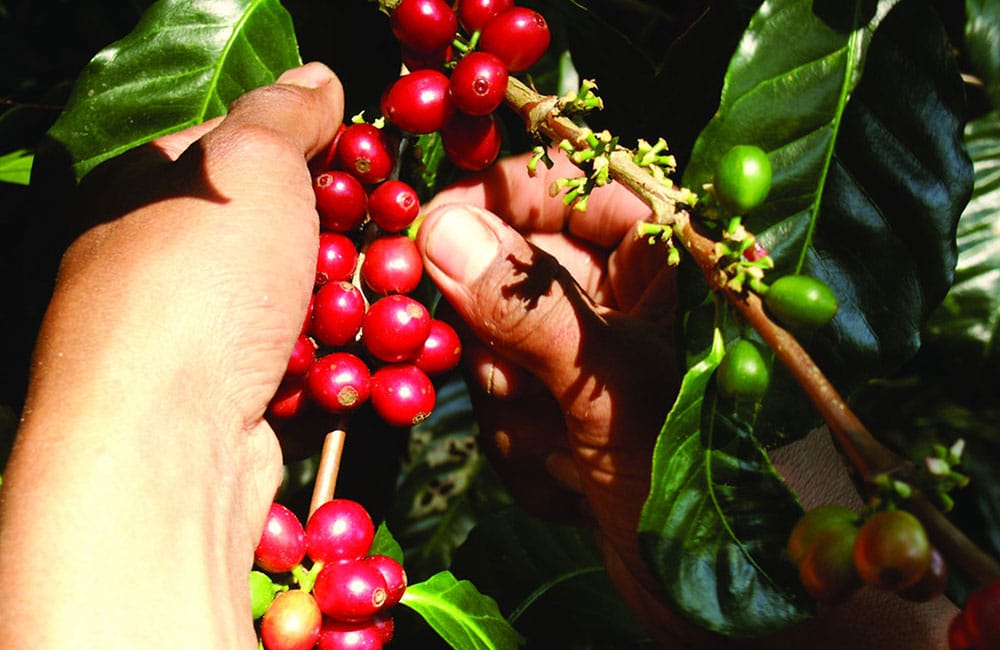
Harvesting is done by hand, cherry by cherry, ensuring careful selection of ripe fruit.
This practice, although labour-intensive, is essential for maintaining the quality of Guatemalan coffee.
A smaller second harvest, known as the “mitaca”, may take place between May and July, although its volume is limited and most of it is destined for domestic consumption.
This seasonality makes Guatemala a key supplier in the international specialty coffee calendar, with fresh beans reaching the market during the first half of the year.
Coffee Growers in Guatemala and Other Industry Players
In Guatemala, the key players in coffee are small and medium-sized farmers, who are responsible for most of the production.
Many of them belong to cooperatives, which provide access to better prices, training and development projects. Their role is essential to the rural economy, as coffee represents the main source of income for thousands of families.
Income varies, but specialty coffee has enabled producers who focus on quality to achieve higher prices in international markets.
However, they also face challenges such as market volatility, climate change and pests.
Other important players include intermediaries, who connect producers with exporters, and the Guatemalan government, which through the Asociación Nacional del Café – Anacafé – promotes quality and international promotion programmes.
Export companies also play a decisive role, ensuring that Guatemalan coffee reaches roasters and consumers around the world.
Together, this ecosystem has made Guatemalan origin coffee synonymous with quality, tradition and diversity on the global stage.
Where to Buy the Best Coffees from Guatemala

We hope this article has helped you learn a little more about Guatemalan coffee, an origin that wins over everyone who tries it.
If you want to discover more about Central American specialty coffees, you can find them at Ineffable Coffee, freshly roasted in Seville with the same care that coffee farmers put into cultivation and harvesting.
Visit our shop to discover some of the delicious high-altitude specialty coffees available both ground and as whole beans, and enjoy an excellent cup of coffee, whether prepared as espresso or filter coffee.