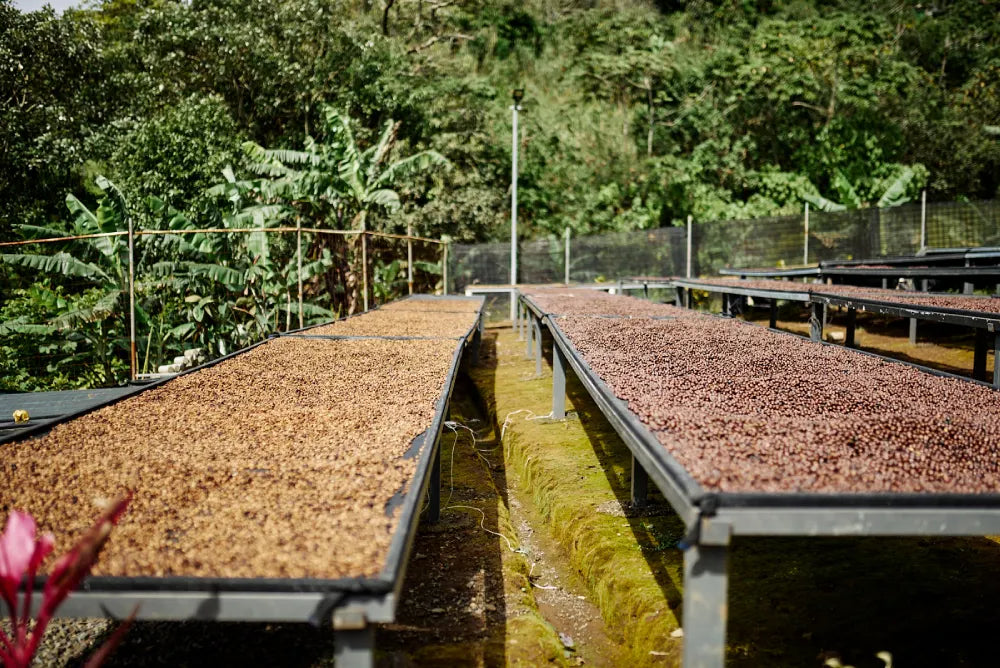
Despite being the smallest country in Central America, El Salvador has made a name for itself internationally thanks to its high-quality coffee.
Coffee cultivation in the country began in the 19th century and soon became the backbone of its economy.
Today, El Salvador coffee is recognised not only for its smooth and balanced flavours, but also for its cultural and social role in Salvadoran life.
In every mountainous region, coffee has shaped landscapes, communities and traditions, becoming a flagship product that carries the country’s identity in every cup.

History of coffee cultivation in El Salvador
Coffee arrived in El Salvador in the early 19th century and quickly found favourable conditions in its volcanic soils.
By the middle of the century, the government encouraged production through policies that offered benefits to those engaged in coffee cultivation. These measures turned coffee into the driving force of the country’s economy.
For decades, Salvadoran coffee dominated exports and generated wealth, although it also contributed to social inequalities due to the concentration of land in the hands of a small number of coffee-growing families.
Nevertheless, production continued to grow and consolidated El Salvador’s reputation as a producer of fine coffees.
Over time, the civil war and economic crises affected the sector, reducing its prominence in the national economy. Even so, the efforts of coffee growers and the focus on specialty coffee have allowed El Salvador to regain its prestige, establishing it as a key origin in the global high-quality coffee market.

The importance of coffee in the economy and culture of El Salvador
Coffee has historically been a pillar of El Salvador’s economy, generating employment, foreign currency and development in rural areas.
For much of the 20th century, more than 50% of exports came from coffee, making it the foundation of the national economy. Although its share is smaller today, it remains an essential source of income for thousands of families.
Culturally, coffee is part of Salvadoran identity. It is present in everyday life, from the family breakfast table to gatherings with friends.
Furthermore, coffee from El Salvador has inspired literature, music and traditions surrounding the harvest. Many coffee-growing communities hold local festivals connected to harvesting, reinforcing the bond between people and the land.
Today, coffee is valued not only as an export product, but also as a tourist attraction.
The rise of coffee routes, where visitors tour farms, learn about cultivation processes and taste different varieties, demonstrates that coffee continues to be a cultural ambassador for El Salvador around the world.

The evolution of coffee cultivation, production and varieties in El Salvador
El Salvador has undergone major changes in the way it grows and produces coffee. Initially, the focus was on quantity, with large estates dedicated to mass exports.
However, following coffee crises and falling prices in the international market, the country shifted its strategy towards quality.
Today, El Salvador is known for its production of specialty coffees, with internationally recognised varieties such as Pacamara ––a hybrid of Pacas and Maragogipe, originating in the country itself––, Bourbon, Pacas and Typica.
These varieties have won international competitions and are highly valued for their balanced flavour, silky body and sweet notes with floral and citrus nuances.
Although production has declined in volume, cultivation and processing methods have become more sophisticated. Small producers, organised in cooperatives, are embracing natural, honey and washed processes, which bring a diversity of cup profiles.
Thus, El Salvador has evolved from an intensive production model to a specialised one that prioritises quality and sustainability.

Coffee cultivation methods in El Salvador
Salvadoran coffee is mainly grown on mountain slopes and volcanic soils, which provide unique minerals to the plants.
Altitudes between 1,000 and 1,800 metres above sea level favour the production of specialty coffees with bright acidity and distinctive aromatic notes.
Coffee growers generally use traditional methods combined with modern techniques that improve bean quality. The most common is shade-grown cultivation, using native trees to protect coffee plants, promote biodiversity and retain soil moisture.
This not only contributes to quality, but also makes cultivation more sustainable.
When it comes to processing, El Salvador is a pioneer in experimentation. In addition to the classic washed process, honey and natural processes have become increasingly popular, enhancing the fruity and complex flavours of the beans.
This innovation has allowed Salvadoran coffees to stand out at international auctions and establish themselves as one of the most interesting origins in Central America.

Main coffee-growing regions in El Salvador
Although it is a small country, El Salvador has several producing regions that offer unique cup profiles thanks to its volcanic geography, altitude and microclimates.
Apaneca-Ilamatepec Mountain Range coffee-growing region
- Location: Western El Salvador, departments of Ahuachapán and Sonsonate.
- Areas: Chalchuapa, Juayúa, Concepción de Ataco.
- Production: the country’s main coffee-growing region, producing more than 50%.
- Varieties: Bourbon, Pacamara, Pacas.
- Altitude: 1,200 to 1,700 metres.
- Climate: temperate and humid, with abundant rainfall.
- Cultivation: traditional shade-grown cultivation.
- Processing: washed, honey and natural.
Bálsamo-Quezaltepec Mountain Range coffee-growing region
- Location: Central-western region, near San Salvador.
- Areas: Santa Tecla, Comasagua, Jayaque.
- Production: accounts for 20% of national production.
- Varieties: Bourbon, Typica and Pacas.
- Altitude: between 1,000 and 1,500 metres.
- Climate: mild, with oceanic influence.
- Cultivation: medium-sized and small farms under shade.
- Processing: washed processing predominates.
Alotepec-Metapán Mountain Range coffee-growing region
- Location: Northwestern region, on the border with Honduras and Guatemala.
- Areas: Metapán, La Palma, Citalá.
- Production: between 10% and 15% of national production.
- Varieties: Bourbon and Pacas.
- Altitude: between 1,300 and 1,600 metres.
- Climate: mountainous, with distinct seasons.
- Cultivation: traditional agriculture, shade systems.
- Processing: mainly washed.
Other coffee-growing regions in El Salvador worth knowing
There are several other notable coffee-growing regions in El Salvador worth discovering, such as Chichontepec, Tepeca-Chinameca and Cacahuatique, each with its own character.
Coffee from Chichontepec, grown on the slopes of San Vicente Volcano, is distinguished by its balance, mild acidity and notes of caramel and citrus. In Tepeca-Chinameca, volcanic soils and altitude produce aromatic beans with medium body and flavours of ripe fruit and cocoa.
Finally, Cacahuatique, in the eastern part of the country, produces bright and sweet coffees with clean, floral profiles. Three regions that reflect the richness and diversity of Salvadoran coffee.

Coffee harvest season in El Salvador
The harvest season in El Salvador varies depending on altitude and region, but generally runs between November and March.
In lower-altitude areas, such as Bálsamo-Quezaltepec, harvesting begins earlier, while in higher-altitude areas, such as Apaneca-Ilamatepec, it can continue until March.
Harvesting is done by hand, allowing only ripe cherries to be selected and ensuring higher bean quality. This labour-intensive process is also a key source of seasonal employment for thousands of rural families, who depend on the harvest as their main annual source of income.
During this season, many communities organise fairs and celebrations related to coffee, reflecting the strong cultural connection between the population and this crop. In fact, the harvest is not only an agricultural activity, but also a social and community event.
Coffee growers in El Salvador
Salvadoran coffee growers, mostly small and medium-sized producers, are the main guardians of the country’s coffee heritage.
Many of them work in cooperatives that facilitate marketing, access to credit and the implementation of sustainable practices.
The income they earn often varies according to the quality of their coffee and international market dynamics. For this reason, many producers have opted for certifications such as Fair Trade and organic, which allow them to access better prices.
In addition to producers, other actors are involved in the coffee chain:
- Intermediaries and exporters: channel coffee to international markets.
- The government of El Salvador: promotes technical support and financing programmes.
- Private companies and NGOs: collaborate on sustainability and training projects.
Despite challenges such as climate change and coffee leaf rust, Salvadoran coffee growers remain passionate about a product that has shaped the country’s history, economy and culture.

Where to buy the best El Salvador coffees
This article has surely helped you discover an origin that, although not easy to find on the market, wins over the palate of those who try it.
If you are curious to taste some of the specialty coffees from Central America, at Ineffable Coffee you can find them freshly roasted in Seville, with all the care and expertise needed to preserve the value chain to the very end.
Visit our shop to get your hands on some of the high-altitude Latin American specialty coffees available both ground and whole bean, and enjoy a surprising coffee.