
Skip to content

Free Cold Brew ebook with your order

Free shipping on orders over €40 for Spain (Peninsula), Balearic Islands and Portugal. Shipped within 24/48h Mon-Fri

Free shipping to Europe on orders over €99

Cart

Your cart is empty

Betania Farm Papayo

Sale price29,00€

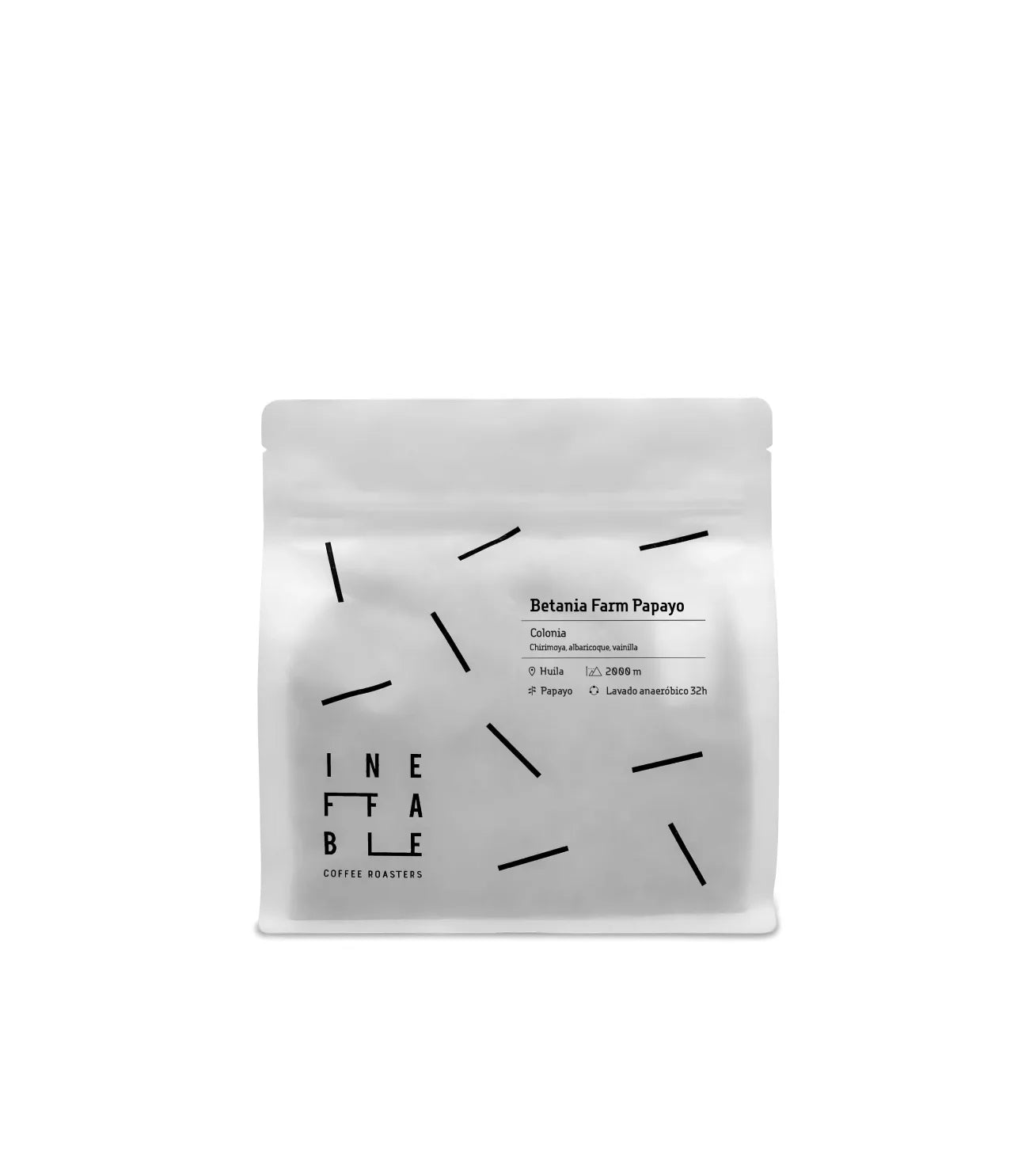
In the mountains of Huila, at 2,000 metres above sea level, Betania farm and producer Linarco Rodríguez represent a new generation of Colombian coffee built on collaboration, sustainability and precision.

This Papayo variety lot offers a fruity and juicy flavour profile with notes of cherimoya and apricot. A base of vanilla and jelly sweets is complemented by a subtle maple finish. Long-lasting aftertaste with vibrant acidity and a silky body.

Format:

Format:

Whole bean-Ground:

Whole bean-Ground:

Whole bean-Ground:

Reviews of our product

Fresh seasonal coffee

Freshly roasted in Seville

Eco-Friendly Packaging

Fair price

Caution to producers

Traceability from farm to cup

Learn more about the product

Learn about this coffee in detail

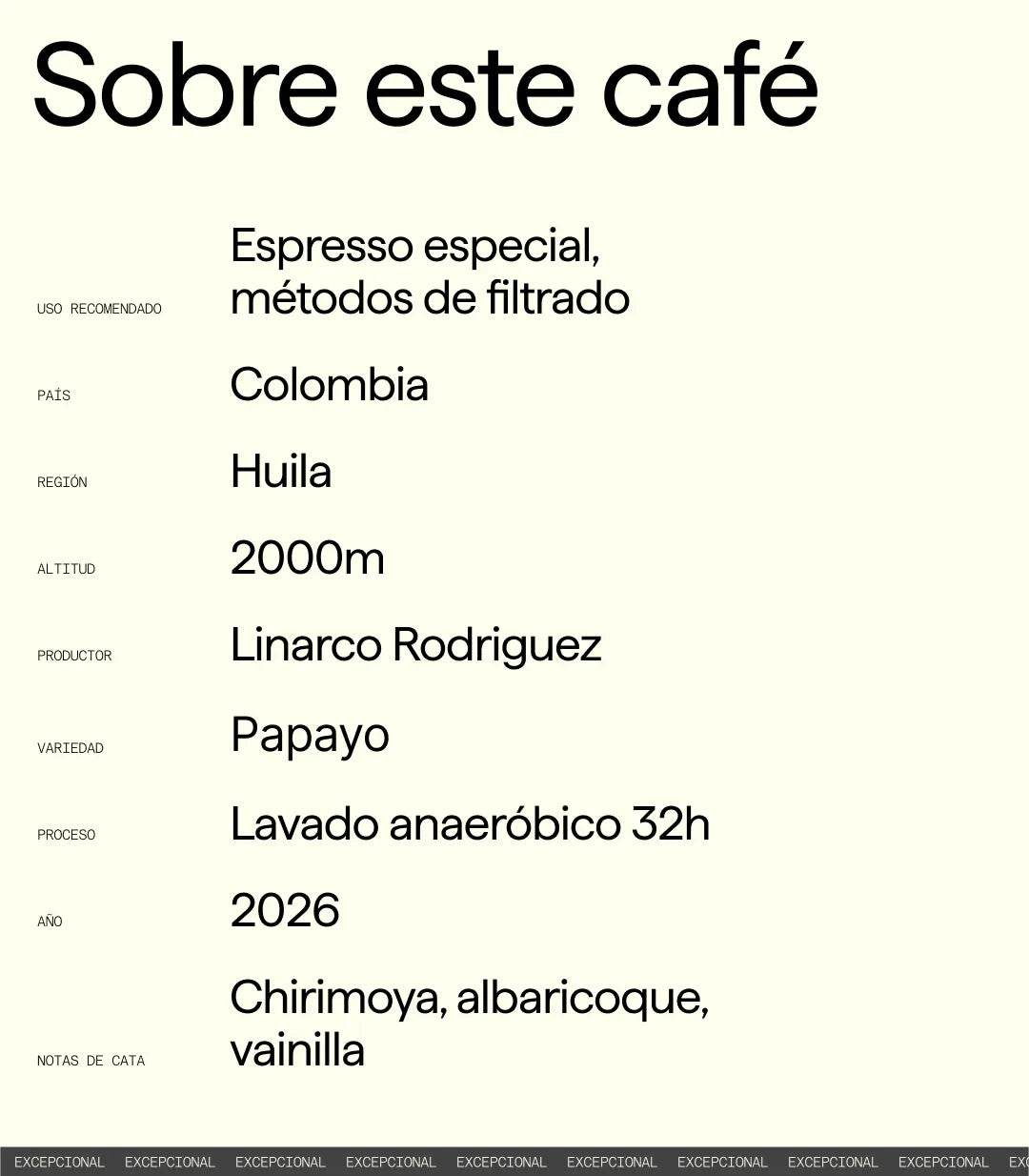
In the mountains of Huila, at 2,000 metres above sea level, Betania farm and producer Linarco Rodríguez represent a new generation of Colombian coffee built on collaboration, sustainability and precision.

Integrated within a network of 117 small producers, this project combines tradition with continuous improvement, sharing key infrastructure such as cupping laboratories and drying stations to raise quality standards and ensure full traceability.

Known as “Don Lino”, Linarco leads with humility and innovation, championing practices such as selective cherry picking and careful fermentation control. 

This Papayo variety lot undergoes a meticulous washed process with 32 hours of anaerobic fermentation, followed by slow drying on African beds.

The result is a clean, complex and expressive coffee that faithfully reflects the unique potential of Huila.

Meet the producer

Betania Farm Papayo: the Colombian coffee that turns tradition into precision

A coffee born in the mountains of Huila

At 2,000 metres above sea level, in the mountains of southern Huila, a coffee is born that clearly reflects everything that makes this region of Colombia so special. Betania Farm Papayo is not just a single-origin coffee; it is the result of a precise combination of place, people, knowledge and dedication.

Huila has become one of the most recognised names in specialty coffee thanks to its exceptional natural conditions. Altitude, fertile soils and a stable climate create the perfect environment for producing coffees that are complex, expressive and full of nuance. But behind this lot there is something even more important: the people who make it possible.

Betania Farm is part of a network of 117 smallholder producers working collaboratively under a shared philosophy: producing high-quality coffee while respecting the land and preserving sustainable farming practices. Rather than competing with one another, they share key infrastructure such as cupping laboratories, professional drying stations and centralised warehouses. This allows them to consistently improve quality while ensuring full traceability at every stage of production.

This collaborative model not only elevates cup quality, but also creates a fairer and more sustainable structure for the families involved.

Don Lino and a new generation of Colombian coffee

At the heart of this project is Linarco Rodríguez, affectionately known as “Don Lino”. He represents a new generation of Colombian producers that combines tradition, experience and innovation.

Don Lino has spent years refining every aspect of his production, introducing improvements in selective harvesting, fermentation control and drying techniques. His work goes beyond his own farm: he shares knowledge with other producers in the region and promotes more environmentally responsible farming practices.

This open and collaborative mindset is clearly reflected in the cup. The coffee is balanced, clean and precise, yet also deeply connected to its origin and the people behind it.

The Papayo variety and a carefully designed process

This lot uses the Papayo variety, a cultivar increasingly valued in specialty coffee for its intense aromatic profile and its ability to develop complex, fruit-driven flavours.

The process begins with highly selective hand-picking. Only fully ripe cherries are harvested to ensure optimal sweetness and uniformity. The cherries then undergo flotation in clean water to remove any defective or underripe fruit.

After pulping, the coffee undergoes a 32-hour anaerobic fermentation in a low-oxygen environment. This step is key to developing complexity and depth without introducing over-fermented characteristics. The coffee is then carefully washed and slowly dried on raised African beds for approximately 20 to 25 days.

The result is a clean, elegant and highly expressive coffee.

A juicy, complex and silky cup

In the cup, Betania Farm Papayo stands out for its distinctly fruity and juicy profile. Notes of cherimoya and apricot appear from the very first sip, supported by a sweet base reminiscent of vanilla and jelly sweets, with a delicate maple undertone.

The acidity is vibrant yet balanced, bringing freshness and clarity, while the silky body wraps the entire experience. The finish is long, clean and persistent, leaving a refined sweetness on the palate.

This is an ideal coffee for filter brewing methods, where its full clarity and complexity can shine, although it also offers a particularly interesting experience as espresso for those seeking more modern, fruit-forward profiles.

Each cup of Betania Farm Papayo tells a story of collaboration, innovation and respect for origin. A coffee that not only tastes exceptional, but also reflects the remarkable human and agricultural potential of Huila.

Recetas para este café

Special Process Coffees Filter

The following recipe is a guide designed for brewing coffee at home. Results may vary depending on your equipment, settings, and all the variables that influence extraction.

With each coffee we roast, our team conducts tests to find a recipe that highlights all the coffee's qualities. The one you'll see below includes all the necessary information to reproduce it. Even so, we always recommend trying and experimenting to discover what you like best: use it as a guide and adapt it to your liking.

Remember: the journey is more important than the destination.

To consider: Water is the most important factor for achieving a great cup of coffee. Depending on where you live, its composition can vary drastically. Therefore, we recommend using at least filtered water; another option is a mixture of Bezoya and Lanjarón. When adjusting the recipe, change only one variable at a time to be able to identify how it influences the flavor.

It's common to start by adjusting the coffee-to-water ratio. Once you get a cup with a pleasant intensity and mouthfeel, you can modify other aspects of the extraction.

Most pour-over coffee recipes use a ratio between 1:15 and 1:17, with a brew time of between 2:30 and 4:30 minutes.

Kalita / Origami / Orea

We have chosen this method to share our recipes because it is very versatile and easy to adapt to other pour-over systems. The flat bottom and wavy folds of Kalita filters create a wide surface that prevents significant flow blockages caused by the migration of fine particles or clogging.

Kalita/Origami/Orea

Recipe:

  • Ratio: 1:17
  • Coffee: 20g
  • Water: 340g
  • Total time: 3:20-3:50min
  • Temperature: 94ºC

Variables:

  • Resting time: Minimum 8 days after roasting, but best expressed after 12-20 days.
  • Water: 100% Bezoya
  • Filter: Kalita 185

Equipment:

Kalita/Origami/Orea, Kalita filter, Scale, timer, grinder, cup/decanter, and gooseneck kettle.

Method:

  1. Place the Orea in a cup/decanter and insert the filter. Pour hot water to eliminate the paper taste and preheat the equipment.
  2. Grind the coffee to your recommended level.
  3. Discard the water and place the Orea on the scale. Add the coffee, distributing it evenly. Tare the scale and start the timer.
  4. Pour 60g of water in circular motions and wait 30-40 seconds for the coffee to degas. If the coffee has been recently roasted, allow more time.
  5. Slowly pour water until you reach approximately 200-250g, and swirl the Orea once to level the coffee bed and ensure it is fully saturated with water. Never fill to the brim; leave at least a 2 cm space from the top to limit water bypass through the coffee bed, which reduces extraction.
  6. Continue pouring water slowly as before until you have added the required amount of water.
  7. Swirl one last time and let the water drain.
  8. We are aiming for a total time according to the recipe. Adjust the grind size if necessary next time.

Espresso

Here's our most up-to-date recipe. It's important to remember that this recipe is a reference and that many variables will influence the final result of the espresso in your cup: from the condition of your machine and grinder, the water you use, the storage/brewing time of your coffee, to the temperature/pressure, etc. Therefore, you may need to adjust some parameters to achieve a flavorful and balanced espresso based on your specific needs and equipment.

Recipe:

  • Ratio: 1:2.1
  • Dry: 18gr
  • In cup: 38gr
  • Time: 30-36s

Variables:

  • Resting time: minimum 2 weeks
  • Temperature: 94ºC
  • Pressure: 6 bars
  • Pre-infusion: No
  • GH 60 (ppm as CaCO3) KH 30 (ppm as CaCO3)

Machinery and equipment used for this recipe:

  • Espresso machine: La Marzocco PB 2GR
  • Grinder: Mahlkonig
  • Scoop: 22gr VST (without slot)
  • Extras: Barista Hustle WDT, Push Tamper (flat, 100% level)

Cold brew

[ Watch the recipe video ]

When making Cold Brew, we typically make larger quantities than with other brewing methods. So, we're providing a recipe for one liter of Cold Brew. If you want to make more or less than this amount, the ratio is 1:14; 1g of coffee for every 14g/ml of water.

Recipe and equipment:

Preparation:

  • Grind the coffee to a medium/coarse grind
  • Place the coffee directly into the filter of the pitcher or bottle
  • Pour the pre-weighed water into the pitcher or bottle
  • Stir gently to saturate all the coffee
  • Cover the container
  • Let it steep for 16-24 hours in the refrigerator (be careful with strong odors!)
  • After this steeping time, remove the filter with the coffee, and it's ready.

BONUS:

Bonus 1:You can do an additional filtration with a V60 paper filter, Kalita, cheesecloth, or something similar to get a cleaner and clearer result.

Bonus 2:For the best flavor, consume as soon as it's ready, as it will oxidize over time.

Bonus 3:Do not shake or press the coffee to avoid extracting bitter flavors or sediment.

Bonus 4:You can freeze Cold Brew into ice cubes and use them to chill your Cold Brew or for making other drinks.

Bonus 5:Food safety: wash your hands and utensils properly. Keep for a maximum of 3 days in the refrigerator in a glass container, preferably closed and without additives (sugar, milk, etc.).

Related products

FREE SHIPPING

Spain (Peninsula)

>40€ / Delivery 24/48h LV

Balearics

>40€ / Delivery 3/5 days, LV

Portugal

>40€ / Delivery 3/5 days, LV

Europe

>99€ / Delivery 4/7 days, LV

See more...